

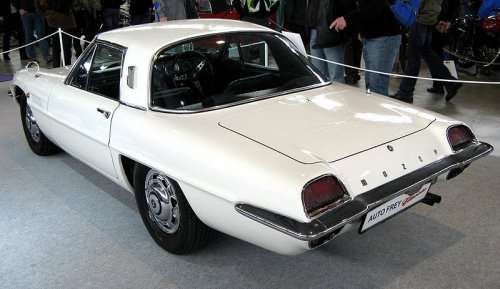
Tuesday 30th May 1967
The Mazda 110S Cosmos, the world’s first two-rotor rotary engine production car, was officially launched with NSU rotors, beating even NSU’s own Ro 80 to market by 3.5 months. Mazda paid NSU hefty licence fees for the use of the Wankel design, and all Mazda rotor housings had ‘NSU licence’ cast into them. The Series I/L10A Cosmo was powered by a 0810 two-rotor engine with 982 cc of displacement and produced about 110 hp (thus the 110 name). It used a Hitachi 4-barrel carburetor and an odd ignition design – two spark plugs per chamber with dual distributors. A 4-speed manual transmission and 14 inch (335 mm) wheels were standard. In Japan, the installation of a rotary engine gave Japanese buyers a financial advantage when it came time to pay the annual road tax in that they bought a car that was more powerful than a traditional inline engine, but without having the penalty for having an engine in the higher above-one-litre tax bracket. The front independent suspension was A-arm/coil spring design with an anti-roll bar. The rear used a live axle with a de Dion tube, trailing arms, and semi-elliptic leaf springs. Power-unassisted 10 inch (254 mm) disk brakes were found in front with 7.9 inches (201 mm) drum brakes in the rear. Performance in the quarter-mile (400 m) was 16.4 s, with a 115 mph (185 km/h) top speed. The price was lower than the Toyota 2000GT at 1.48 million yen (US$4,100).