

Monday 23rd March 2009
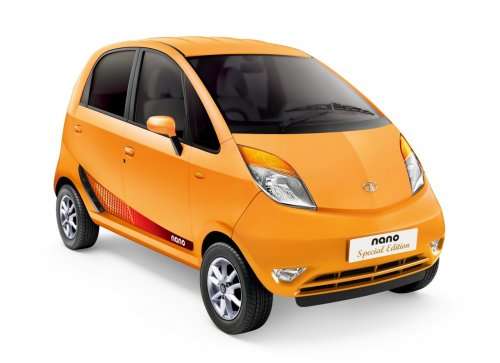
India’s Tata Motors launched its ultra-cheap ($2,000) two-cylinder 624 cc Nano car in Mumbai. The vehicle was hoped to herald a revolution by making it possible for the world’s poor to purchase their first car.
Creative cost-saving was evident throughout the Nano. Flat side glass, a single wiper and no tailgate, three wheelnuts instead of four and a single door lock all help to keep the price low. But although the entry-level model was spartan, the CX and LX models had air-con. Incredibly for such a cheap car, a huge range of accessories and customisation options are offered, from decal sets to bodykits and dashboard trims.
The 625cc, twin-cylinder engine develops 35bhp, but with only 600 kg to carry, a 50-55 mph cruise was achievable. The low weight meant that all-round drum brakes could be utilised. Despite the cheaper technology, the Nano had independent suspension front and rear, but was designed without anti-roll bars. With such a small engine, fuel consumption was variable with load and speed, but 55mpg was an easy average. The steering, not power-assisted, was light at parking speeds, and reasonably sharp. It rode well over India’s terrible roads, thanks in part to tall 65 and 70 section tires.
The second-generation Nano was expected to be sold in the United States by 2015. The original Nano is not street legal in the US, and cannot legally be sold as a grey market import until 2034, when the original 2009 models receive a 25-year exemption from the US Customs and Border Protection. Despite a readily-available dealership network in the US through the Jaguar Land Rover division of Tata, Tata Motors will not use Jaguar Land Rover to sell the Nano.